Formula SAE
Steering Column
AFR 2024-2025

For the 2026 vehicle, I was a key contributor to a project to redesign the steering column, a critical system for vehicle control and driver feedback. As a joint project with my subteam lead, my primary responsibilities included conducting a trade study for system selection, creating the complete SOLIDWORKS assembly for the column, performing the hand calculations to validate the system's torsional stiffness, and assisting with the overall integration.

The project began with a comprehensive trade study to make a data-driven decision on the steering column's core architecture. I analyzed five distinct configurations, including direct transmission, various universal joint setups, and a bevel gearbox. Each option was systematically evaluated and scored against a weighted set of criteria, with a strong emphasis on safety, stiffness/play, cost, and ergonomics. The two single U-joint configuration emerged as the definitive choice. This design was selected for its superior packaging flexibility which allowed for a compact and well-supported system and high efficiency in transmitting driver inputs. This rigorous, upfront analysis was foundational, ensuring the chosen architecture met our complex set of performance and safety goals before we proceeded with detailed design.

Following component selection, I was responsible for the detailed CAD modeling and system integration of the steering column. To ensure optimal packaging, I developed a master sketch within the steering column assembly, which defined the precise lengths of the steering shafts and the placement of the universal joints. This dimensioned sketch was critical for routing the column to clear all chassis tubes while simultaneously providing adequate legroom for the driver. The final placement was then validated against both 95th percentile male and 5th percentile female driver templates to confirm proper ergonomics. Furthermore, this process was guided by strict adherence to FSAE regulations; for example, the sketch was used to verify that the top of the steering wheel remained below the highest point of the front hoop, satisfying rule F.5.7.4. The final CAD assembly integrated all components into a cohesive unit that was fully validated for fit, ergonomics, and rules compliance.
Validation/Analysis
Phase
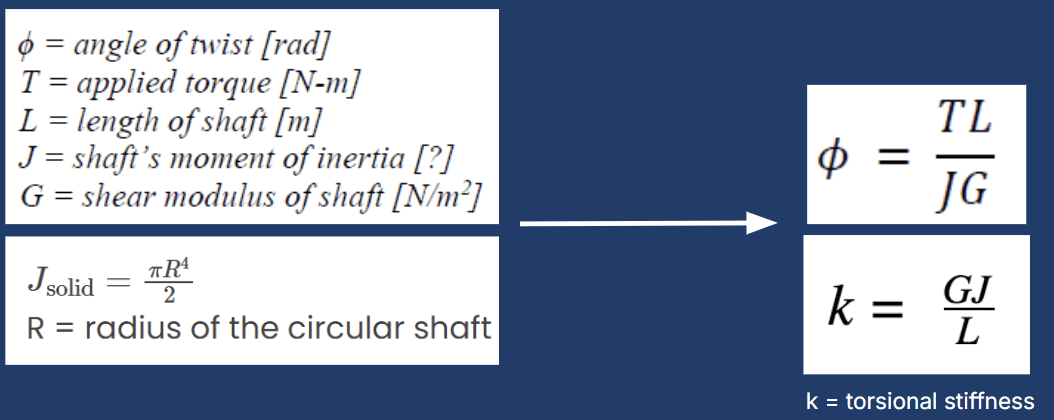
A core requirement for this project was to validate all design choices with rigorous analysis. We performed the hand calculations to determine the torsional stiffness of the entire steering shaft assembly. Using the formula for angular deflection, we calculated the total twist of the system under an applied torque of 100 N-m. The analysis showed a total angular twist of only 1.767 degrees, confirming that the design was sufficiently stiff to provide the direct, responsive feedback required in a competition vehicle.
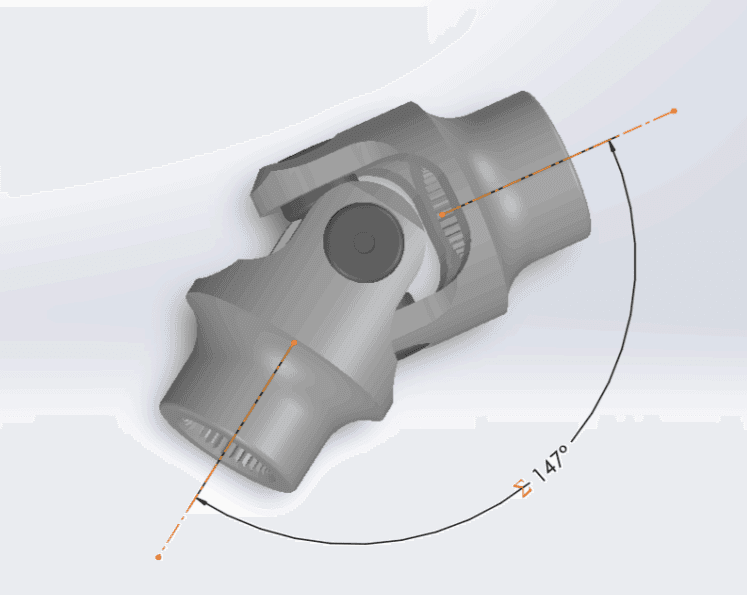
Furthermore, we addressed the torque and velocity variations commonly seen in steering assemblies with double u-joints or two single u-joints, which is caused by improperly phased and mismatched operating angles. For the new design, we ensured the U-joints were co-planar with identical spatial angles. This corrected phasing effectively cancels out the sinusoidal variations, resulting in a smooth, 1:1 transfer of motion from the steering wheel to the steering rack. This comprehensive approach ensured our final design was not only functional and ergonomic but also robust and reliable.




Given some more validation and slight adjustments to CAD for packaging, this steering system will be approved and manufactured for Anteater Formula Racing's next car, Banshee.